At some point, every CTO hits this question.
What tech stack should we choose for our mobile app?
It sounds like a technical decision. It’s not.
This choice affects your budget, your speed, your team structure, and how your app grows over time.
Pick the right stack, and things move smoothly. Pick the wrong one, and you’ll feel friction at every stage.
Let’s unpack what actually matters when making this decision.
It’s Not About Trends, It’s About Fit
New frameworks show up all the time.
Each one promises better performance, faster development, or easier scaling.
It’s tempting to chase what’s popular.
But popularity doesn’t mean it fits your product.
Ask yourself:
- What kind of app are we building?
- Who are the users?
- What level of performance do we need?
A simple content app doesn’t need the same setup as a real-time service.
Start with your use case, not the latest trend.
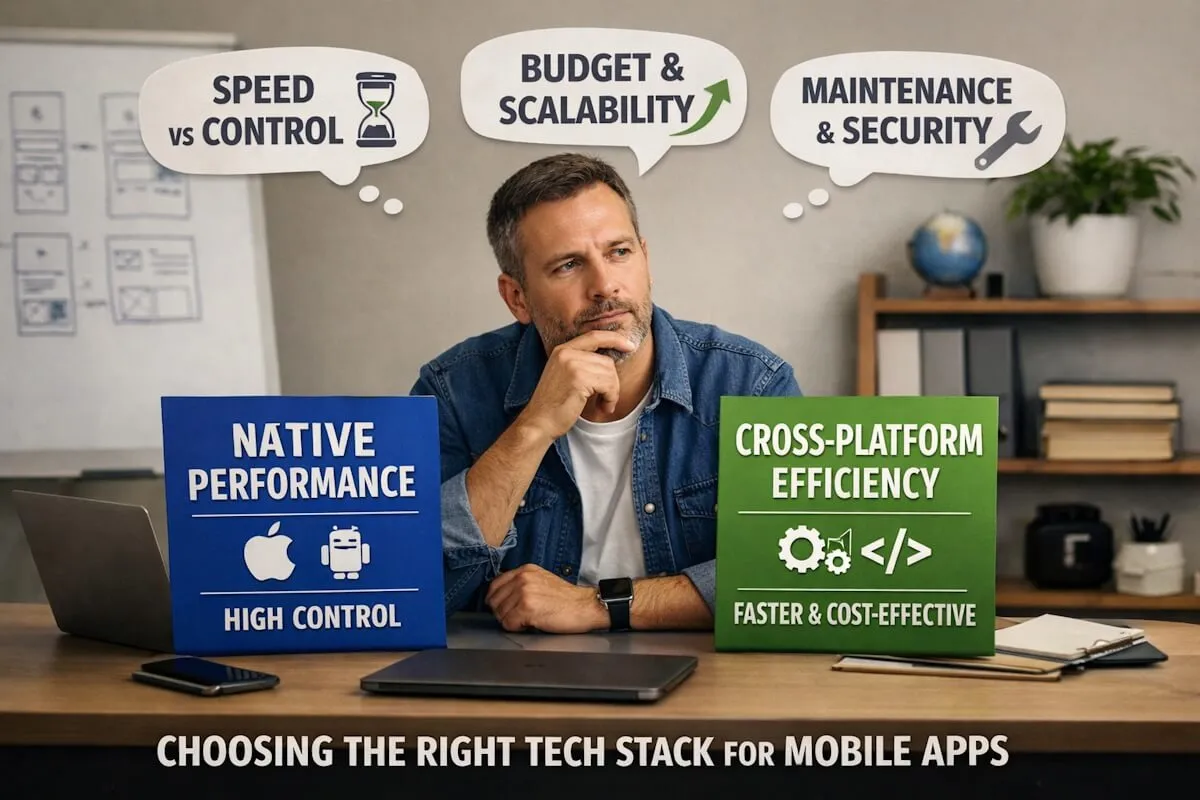
Native vs Cross-Platform Is Still the Big Question
This is where most debates begin.
Native development means building separate apps for iOS and Android.
Cross-platform means using a single codebase for both.
Both approaches work. The difference lies in trade-offs.
Native gives you full control and strong performance. It’s ideal for complex apps with heavy interactions.
Cross-platform saves time and cost. It works well for apps that don’t push device limits.
There’s no universal winner here.
It depends on what you’re trying to build and how fast you need to move.
Speed vs Control Is a Real Trade-Off
If speed is your priority, cross-platform tools can help you launch faster.
You write once and deploy across platforms.
But you might give up some control.
Native development takes longer, but you get deeper access to device features and better performance tuning.
So ask yourself.
Do we need to move fast, or do we need full control?
Your answer shapes your stack.
Team Structure Plays a Bigger Role Than You Think
Your tech stack should match your team, not the other way around.
If your team already has strong experience in a specific technology, that’s a big advantage.
Switching stacks can slow things down.
Learning curves, mistakes, delays.
On the other hand, if you plan to scale your team, think about hiring.
Will it be easy to find developers for this stack?
If not, you might face bottlenecks later.
This is where many companies choose to Hire Mobile App Developers based on the stack they decide, not the other way around.
Maintenance Is Where Costs Show Up
Building the app is just one part.
Maintaining it is where long-term costs appear.
Some stacks are easier to update and manage. Others require more effort over time.
Think about:
- How often will you release updates?
- How easy is it to fix bugs?
- Will you need frequent changes?
A stack that looks cost-effective at the start might become expensive to maintain.
Third-Party Dependencies Can Be a Risk
Most apps rely on external libraries and tools.
They save time, but they also add dependency.
If a library stops being supported or has issues, it can affect your app.
Some stacks rely more heavily on these dependencies than others.
It’s worth checking how stable and widely supported your chosen tools are.
This reduces surprises later.
Performance Expectations Should Guide You
Not every app needs top-level performance.
But some do.
Gaming apps, real-time services, or apps with heavy animations demand more from the stack.
If performance is critical, native development often has an edge.
For simpler apps, cross-platform options usually perform well enough.
The key is to match performance needs with the right approach.
Security Should Be Part of the Conversation
Security is often treated as an afterthought.
It shouldn’t be.
Different stacks handle security in different ways.
Some offer better built-in protection. Others require more manual effort.
If your app deals with sensitive data, this becomes a major factor.
Choosing the right stack early can save you from issues later.
Scalability Is Easier to Plan Than Fix
Your app might start small.
But what happens when it grows?
More users. More features. More complexity.
Some stacks handle scaling better than others.
Planning for growth early is easier than rebuilding later.
This doesn’t mean overcomplicating things from day one.
It means keeping future needs in mind.
The Role of the Right Development Partner
Even the best tech stack won’t save a poorly executed project.
The team behind it matters just as much.
A good Mobile App Development Company helps you choose the right stack based on your goals, not just technical preferences.
They consider your business needs, your timeline, and your long-term plans.
That perspective can prevent costly mistakes.
Avoid Overengineering
This happens more often than you’d expect.
Teams pick complex stacks for simple problems.
Why?
Because they want to “future-proof” everything.
But complexity can slow you down.
More setup. More dependencies. More chances for things to break.
Start simple.
You can always add complexity later if needed.
So, What Should You Actually Do?
Instead of looking for the “best” stack, focus on alignment.
- Does it fit your product goals?
- Does it match your team’s skills?
- Can it handle your growth plans?
- Is it maintainable over time?
If the answer is yes, you’re on the right track.
One Honest Take Before You Decide
There is no perfect stack.
Every option comes with trade-offs.
What matters is choosing the one that fits your situation, not someone else’s success story.
Because what worked for another company might not work for you.
Before You Lock Your Tech Stack
Take a step back before making the final call.
Look beyond features and trends. Think about your team, your users, and your long-term goals.
Because the tech stack you choose today will shape how your app performs tomorrow.
Make it a decision that supports your growth, not one you’ll need to fix later.